
Republished with permission from Steve Schmidt
One month and six days after leading the Allied invasion ashore at Utah Beach, Brigadier General Theodore Roosevelt Jr. shared lunch in Normandy with his son, Captain Quentin Roosevelt II.
The father had landed with the first wave at Utah Beach.
The son had landed with the first wave at Omaha Beach.
Later that afternoon, Roosevelt returned to his command tent, wrote a long letter to his wife, and suffered the fatal heart attack that ended one of the most remarkable lives in American history.
He was 56 years old.
It was 82 years ago today.
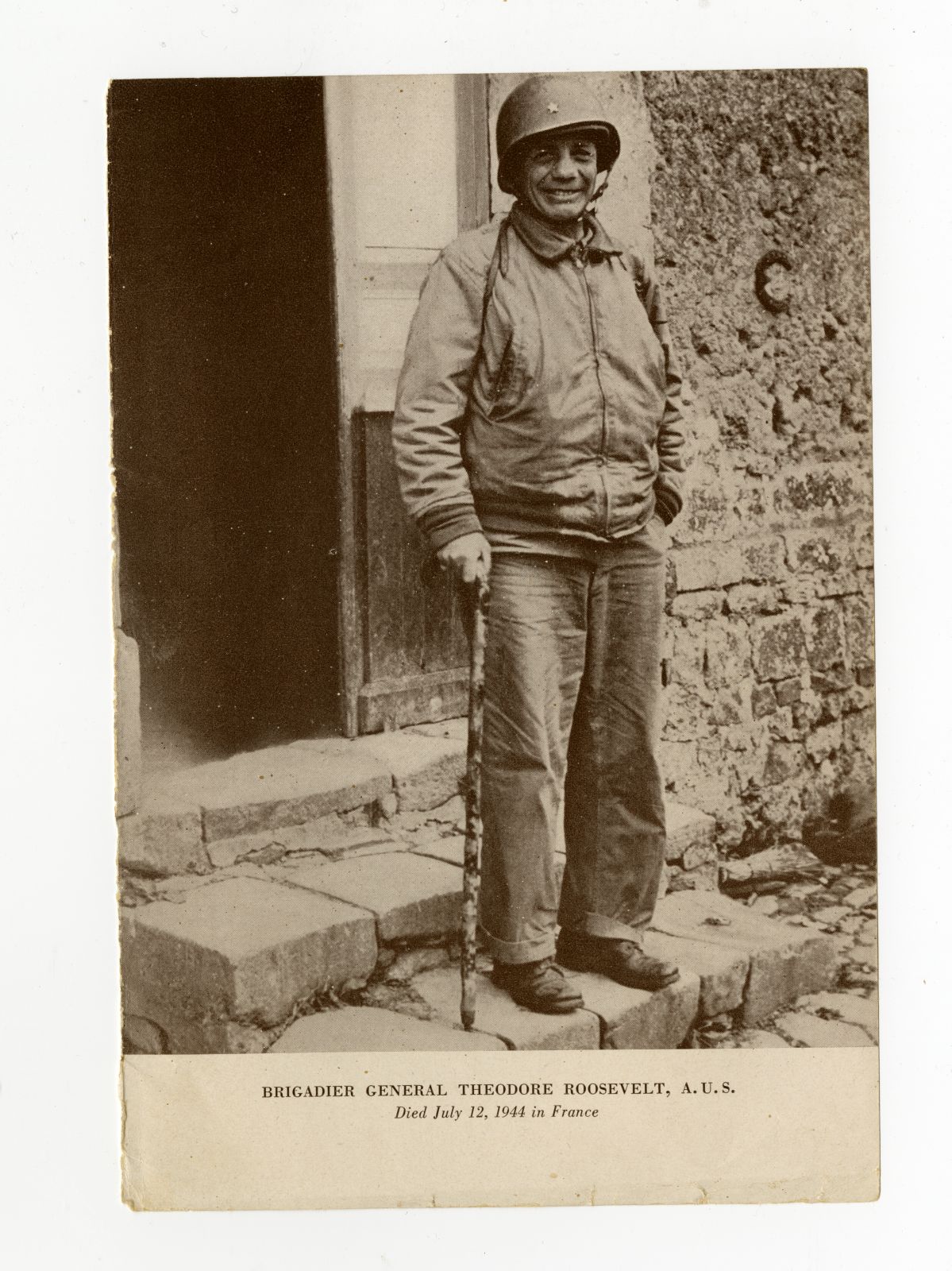
His life deserves remembrance because Theodore Roosevelt Jr. was one of the greatest Americans our country has ever produced.
As a young man, he worried that he would never have a name of his own.
It was an understandable anxiety.
His father was Theodore Roosevelt—the Rough Rider, the trust-buster, the conservationist, the president whose face would one day be carved into Mount Rushmore.
How do you distinguish yourself when your father has already become immortal?
Theodore Roosevelt Jr. never tried to eclipse him. He simply lived a life worthy of the name.
He fought with extraordinary courage in the First World War, earning some of America’s highest valor decorations among them the Distinguished Service cross, and two Silver Stars. He helped found the American Legion because he believed that service to the republic didn’t end when the shooting stopped.
He served as assistant secretary of the Navy, governor of Puerto Rico, governor-general of the Philippines, and later became chair of the board of American Express. He narrowly lost the 1924 race for governor of New York, a campaign that deepened the political divide between the Republican and Democratic branches of one of America’s most extraordinary families.
It was already a remarkable life.
Then came another war.
Serving as assistant division commander under Major General Terry de la Mesa Allen, Brigadier General Roosevelt helped forge the legendary 1st Infantry Division into one of the finest fighting formations of the American Army.
The Big Red One developed two reputations.
The first was for extraordinary combat effectiveness.
The second was for raising hell whenever it came out of combat.
Allen and Roosevelt were largely indifferent to the second reputation.
Their standard was simple: judge soldiers by how they fight.
Men who had survived another campaign had earned the right to celebrate surviving it.
That philosophy offended many career officers, particularly those shaped by the culture of West Point. Omar Bradley believed discipline in garrison and discipline in battle were inseparable.
Allen and Roosevelt believed the battlefield was the only place that ultimately mattered.
Bradley relieved them both after Sicily.
History rendered its own verdict.
Less than a year later, Theodore Roosevelt Jr. was chosen to help lead the greatest amphibious invasion in history.
Major General Raymond O. Barton commanded the 4th Infantry Division. Roosevelt was his assistant division commander.
When Roosevelt insisted on landing with the first assault wave at Utah Beach, Barton tried to stop him.
He knew the odds.
Roosevelt was 56 years old. Arthritis forced him to walk with a cane. His heart had already been weakened by years of strain.
To Barton, it looked like a suicide mission.
To Roosevelt, it looked like duty.
He used every ounce of influence he possessed to ensure he would land with his men.
He believed rank imposed obligation.
If young Americans were expected to step into the surf under enemy fire, then so was he.
Nothing went according to plan.
Currents and confusion carried the invasion force hundreds of yards from its intended landing area.
An officer pointed out the obvious. They had landed in the wrong place.
Roosevelt looked around and replied with one of the greatest sentences in American military history:
We’ll start the war from right here.
It wasn’t bravado. It was command.
Standing in the surf with a cane in one hand and a pistol on his hip, Theodore Roosevelt Jr. reorganized scattered units, identified exits from the beach, directed troops inland, and steadied frightened young soldiers under fire.
Hours later, Barton came ashore expecting to discover that his assistant had been killed.
Instead, Roosevelt was waiting for him. Alive. Calm. Already directing the battle.
For his actions that morning, he received the Medal of Honor. He didn’t live to wear it.
On the night of his death, orders promoting him to major general and giving him command of his own division were already on their way.
He never knew.
There’s a temptation in every generation to confuse celebrity with greatness. They aren’t the same thing.
There’s another temptation to confuse wealth with achievement. They aren’t the same thing either.
Theodore Roosevelt Jr. spent his youth worrying that he would never possess a name of his own because his father’s shadow was so immense.
History solved the problem.
He earned one.
Today, America once again asks young men and women to wear its uniform while too many around political power seem to regard public office as another business opportunity. The Trump family’s cryptocurrency ventures, foreign business relationships, licensing arrangements and other commercial enterprises have generated sustained ethical scrutiny because they raise a question every republic must answer: what is power for?
I have often referred to Donald Trump Jr. and Eric Trump as “Uday and Qusay.”
They are harsh nicknames. They’re meant to be because republics decay when public office becomes a family business instead of a public trust.
Theodore Roosevelt Jr. answered the question differently.
Power existed to serve. Privilege imposed obligation. Honor had to be earned.
Today, Theodore Roosevelt Jr. rests beneath a white marble cross with the lettering etched in gold signifying the grave of a recipient of the Medal of Honor at the Normandy American Cemetery overlooking the English Channel at Colleville-sur-Mer
Beside him lies his younger brother Quentin, the young aviator shot down over France during the First World War. Decades later, the Roosevelt family reunited the brothers so they could rest together.
Walk among those rows of white crosses and something becomes unmistakably clear. Rank disappears. Politics disappears. Fortunes disappear. Fame disappears.
Only sacrifice remains.
If you want to understand what once made America exceptional, don’t begin in Washington. Begin instead at Colleville-sur-Mer.
There, side by side, lie two brothers named Roosevelt.
One died in the First World War.
The other survived two world wars only to die after leading American soldiers ashore on the longest day.
The young man who feared he would never have a name of his own earned one in the only way that truly matters—by living a life of honor.
On this anniversary of his death it warrants reflection around how far we have come—and how far we have fallen.

Steve Schmidt
Steve Schmidt is a political analyst for MSNBC and NBC News. He served as a political strategist for George W. Bush and the John McCain presidential campaign. Schmidt is a founder of The Lincoln Project, a group founded to campaign against former President Trump. It became the most financially successful Super-PAC in American history, raising almost $100 million to campaign against Trump's failed 2020 re-election bid. He left the group in 2021.