
Republished with permission from Steve Schmidt
Writing every day through these awful Trump years can be tedious and depressing, but over time, the words have accumulated a written record that maybe one day—far in the future—my grandkids or theirs might be interested in reading to understand a bit what this era of history was like.
Of course, I won’t be there with them, but my words will make clear what I believed, and where I stood through a tumultuous era during which, unlike many, I could not be made to get on my knees for Donald Trump.
Ever.
Who has been right and who has been wrong over these past years?
Who has been right in the main about the important things?
Who saw the danger clearly?
Unfortunately, there is no register that keeps score in an idiotized society that seems incapable of connecting the events of the next day to the last—let alone the past month or year or decade. Every day is a new opportunity for most media commentators to be wrong again without ever having to worry about being reminded over the instant before when they were wrong last. It is like a 000 license to kill the truth, reality, and in the end, the country.
The great political achievement of the modern Democratic Party has been to lose two out of three presidential elections to the most malignant force in American history, alongside the Confederacy and Ku Klux Klan, led by a man who is a sexual predator, felon, conman and the most prolific liar who has breathed oxygen on Earth since Hitler and Goebbels.
I wrote the following on November 27, 2024, and I’d like to ask you to read it again to help understand this moment in time before the next choice is behind us in 81 days:
What is the national purpose?
Do you believe there has ever been one, or question whether there should be one?
Does the concept seem absurd?
At some basic level, is it even possible to establish one in a country so large, populated, diverse, and deeply individualistic beyond satisfying exigent emergencies?
Perhaps your view is that America’s purpose is hypocrisy or oppression, which is your right, but is not something that will ever be accepted by an American majority, and is refuted by history.
It is a lie as grotesque as the one JD Vance and Trump spread about Haitians eating pets in Springfield, Ohio.
The 2020s alchemy of elitism, aloofness, ideological intensity, dogmatic arrogance and cloistered certitude did as much as the radical west coast prosecutors, crumbling cities, Biden’s ego, Republican cowardice and Democratic softness to elect Donald Trump.
Trump has tried to articulate a national purpose. He calls it MAGA.
I disdain and oppose it. I will continue to do so.
I will argue forcefully that it is not what it claims to be, and what it is can already be seen—if you know what to look for.
Soon it won’t be hard for even the most lackadaisical observer to understand that something bad, not good, is happening. At first, this will be denied. Then it will come to be seen as true, slowly and painfully realized with pain, shame and determination to overcome it. The transgressions ahead will be made against us, by us.
Nothing ahead is going to be new or mysterious. All of it will be deeply rooted in the worst malignancies of America’s past.
Once widely repudiated, the buried furies are now re-emerged.
They have risen, not because they are strong, but because American democracy has grown sclerotic, weak and corrupt.
Fascism thrived in the 1930s because democracy failed in the 1920s across Europe. It was weakness that bloomed depravity.
MAGA is not strong.
MAGA is weak, but not so weak as to be unable to overcome a belligerent, out-of-touch and arrogant status quo that gaslit, deceived and blustered its way to an epic defeat earned by the intense practice of delusional self-interest.
MAGA won because—though it was appalling and disgusting—it was not hypocritical, morally preening and smug.
Those are the high cards in American life and politics. They remain undefeated.
MAGA is a revanchist philosophy that seeks a restoration around something that remains murky to me in the main.
I don’t see the connection between anything Donald Trump has talked about and national greatness.
In fact, my view is that Inauguration Day is race day, the artillery salute is the starting gun, and the first executive order is the opening gate on a four-year track that will end in global and national disaster.
Yet, it is a disaster from which we will recover.
What happens next with regard to the details and specifics is unknowable. However, everyone from Don Jr. to me should agree that the issues at hand and their ultimate disposition is no longer theoretical. The test is at hand.
Someone is going to be right, and someone is going to be wrong.
Trump is going to be the George Washington of Sylvester Stallone’s imaginings, or the Adolf Hitler of Joe Scarborough’s, or perhaps fall somewhere in a vast canyon between the two.
Perhaps he will turn out to be much closer to the dime-store Mussolini of my imaginings.
Who knows?
Certainly it is the case that he won’t be milquetoast or average.
What is coming is going to be very bright or very dim. Because I believe that Trump will do as he says, I know what the answer will be, but I don’t know what it will look like yet.
I believe I will be right, but I would much prefer to be wrong because I want my country to succeed. I don’t believe under Trump that it will.
I think it is highly likely that Donald Trump will triumph at the start. He will execute his plan and exercise vast powers with the force of law and the new immunities of his office relentlessly and successfully. The sheer volume of executive action will be staggering. The new administration will act with aggression and without restraint. It will not be challenged effectively, aggressively, or successfully beyond the margins at first.
This will be called success by many capitulant bootlickers in corporate media. The access age of American journalism will cross over to the even more repugnant one that calls for obsequious niceness to be extended to Trump, whose ego will be fed like an insatiable crocodile.
Yet, some will stand tall and confront what is coming, and say that it is bad. His political success at achieving bad things must be defined as the worst type of failure. It must be defined as a moral failure and an American failure.
The indecency to come will force us at some point to make it stop. When it does there will be much recrimination and rage. The simple truth is that the worst is yet to come, but on the other side, after a loss of identity, we will search again for a deeper purpose as a nation….
I was recently reminded that hindsight can trigger foresight.
The American project is something we share that is much bigger than any one of us.
It existed before any of us, and it will endure after we are all gone.
Death is our shared common destiny. There is no escape from it.
Hope and faith comes from the connection of life to purpose.
Short lives can have great purpose, and long ones can have little.
Purpose is what matters in the life of a nation or a person.
The American disposition towards life has long been that there is great purpose and meaning within each one. This is foundational to our creed.
In that precise moment when Americanism was born and first declared in Philadelphia, it was clear about what was being cast off and being chosen in its stead.
The American Revolution did not fix the ails of the world. It did not eradicate poverty, bigotry, evil, or war. It did not dent slavery. In fact, it guaranteed that the practice would flourish in America until 1865—later than in every other major power.
What it attained was expressed by Gilbert du Montier, in command of American forces at Yorktown at the precise moment of victory, when he was recorded as saying:
Humanity has won its battle. Liberty now has a country.
This was one of history’s most sublime and transcendent moments. It is our birthright and our inheritance.
Liberty has an ephemeral quality because in the American tradition it is a gift from providence, not something made by man that is given to men.
Liberty is practiced in America as faith through its preservation and expansion.
It exists in a state of growth or retraction. MLK talked about this during dark and hopeless days when he said the moral arc of the universe, though long, bends towards justice.
It has bent towards freedom in America in indisputable and myriad ways, but there have been many long, dark nights when liberty has been met with deep hostility by many people in our land.
Those people have not prevailed in our past. Of course, this is not to say they weren’t simply the preface for their progeny’s ultimate success.
Liberty is not genetic. It is not an entitlement.
It is an assertion and declaration.
Always.
There is a magnificent lack of permanence around a great many things in America. We have always existed in a state of change and transition.
America is always in a state of evolution, becoming something new, while remaining anchored to a unique purpose that alternately fades and shines, waxes and wanes. What endures is a soft contradiction of flux and faith.
I love reading my old Life magazines. They are astonishing to touch, open and absorb.
At some level, they are magical. Perfectly preserved time capsules that offer the most profound lessons.
This one is from September 11, 1939:
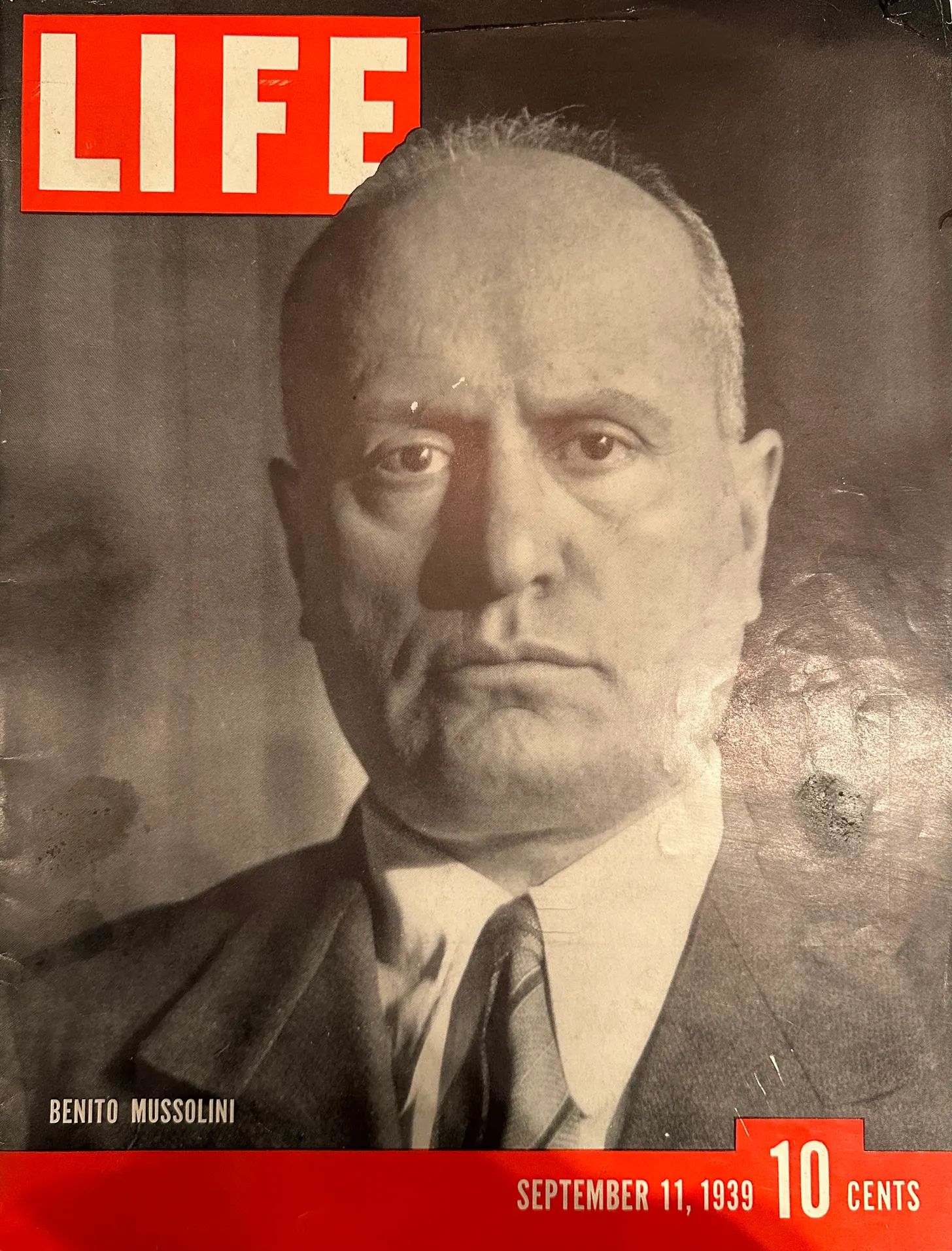
The Second World War was 11 days old. The United States was not a belligerent, and would not be for another 818 days, but that could not be known then.
This is the blurry first photograph of an invading German soldier in Poland:
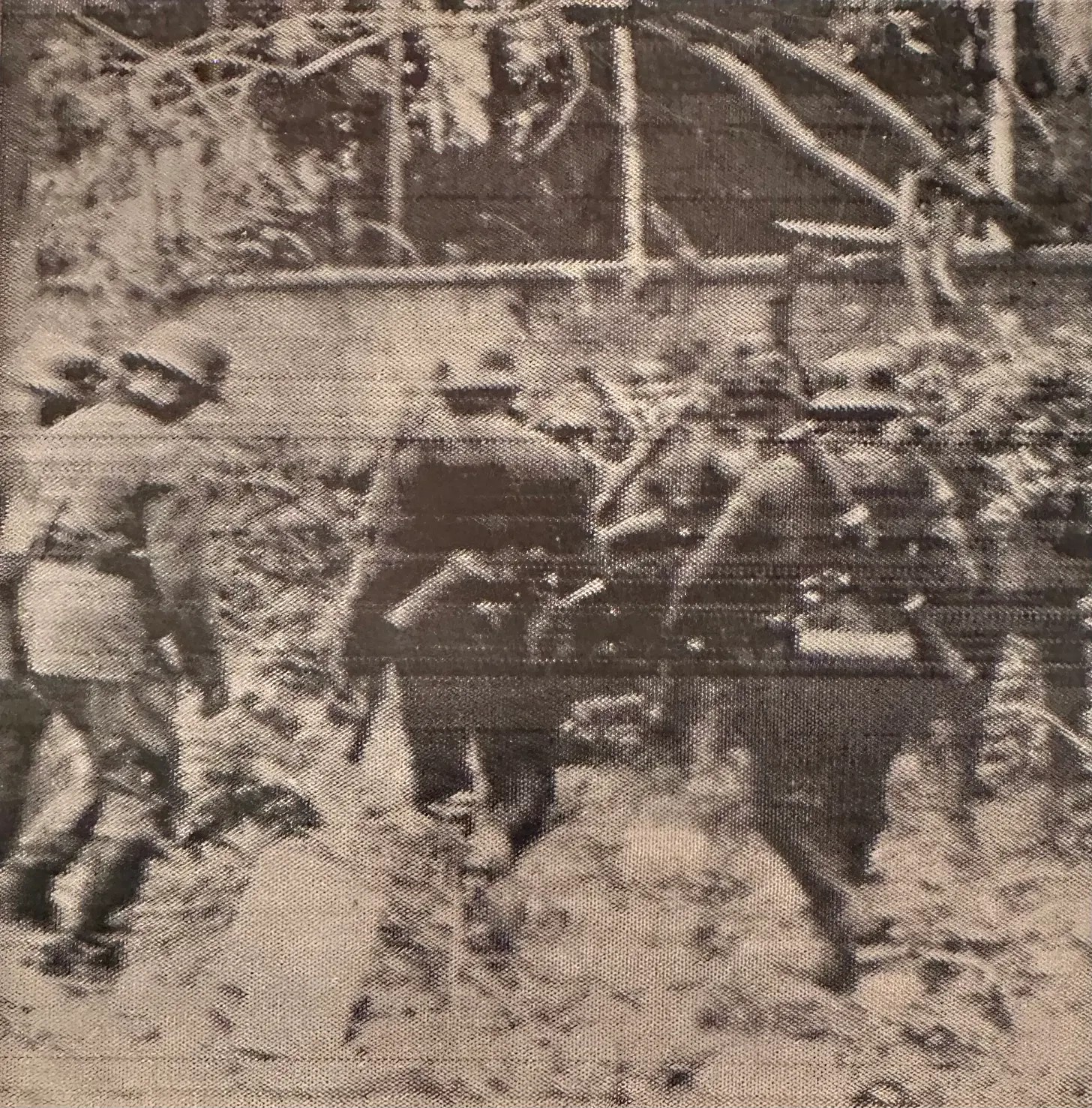
We do not know his name nor do we see his face; only his back as he rushes forward into the abyss to come.
It stopped me cold.
When this magazine was first published, it was not possible to know what came next, or to know what those Nazis would do, but I know now.
We all do.
I know everything the Nazis did. In fact, I know everything that happened for 85 years after the photo was taken.
I stood with Elie Wiesel at Auschwitz 60 years after it was liberated in 2005, which was 66 years after that first photo. It is sobering to think about the coming murder of six million Jews who were all still alive when it was taken.
I thought about the millions of Americans who opened Life in September 1939 with the same deep worry for the future that so many feel now.
The news story that accompanies the photos talks about what preceded the war, and the things done by politicians that made it happen.
The writer makes some sweeping statements about questions long ago and firmly settled around how it all happened. Things were unfocused still in the early days.
Exactly what happened during the feverish diplomatic maneuvers leading up to the declaration of war by Britain and France against Germany, historians of the future will discuss and debate endlessly in their effort to fix war guilt.
Not so much.
History settled the question.
There is a noticeable lack of any American anything being mentioned in the news story in the magazine.
It is disorienting as an American born in 1970 to read about the commencement of the most important, lethal and tragic events in human history without the writer mentioning anything American until the sixth paragraph and 500 words in.
There, Roosevelt is mentioned as having been guaranteed by Hitler that the Nazis won’t bomb civilian populations in Poland.
They did.
The events being covered in the September 11, 1939, edition of Life led directly to what historians recall as the American century.
However, in the moment, the United States was a peripheral player in the second major war to begin in Europe over one generation.
My 21-year-old daughter and her college friends are worried about the sound of the war tocsins.
Every American should appreciate that North Koreans will soon be fighting in Europe, Biden has removed restraints on the use of offensive US weapons by Ukraine, and Russia has launched the first Intercontinental Ballistic Missile from its arsenal in its history.
Nobody should be shouted down for worrying about war, and doubting the competence of US government officials to make wise decisions about life and death matters.
The Vietnam War did not prevent the Iraq war, which tells us that wisdom is hard to pass down. Lessons that should have been indelible in 1975 were lost by 2001—drowned by ignorance, arrogance and certitude.
The lessons were not heeded. The result was two failed wars and a suicide epidemic, driven by deep moral injury inflicted on a generation of Americans sent to make meaningless sacrifices by a failed generation of politicians.
The result is Trump. The rage is real, and the disconnect between America’s elites and her military veterans and families is profound.
Theo Matejko was an artist, an acclaimed illustrator and veteran of World War I.
A Viennese, Matejko imagined something very dark in his dreams.
Here is what he saw:
An idea which came to me years ago with unholy force and persistence was the image of an air attack over a big city in some future war. I saw in this dreadful vision the merciless heavens pouring destruction upon peaceful people…I offer these pictures in the deep and sincere hope that these nightmare visions may never become a reality.
Here is what he drew:
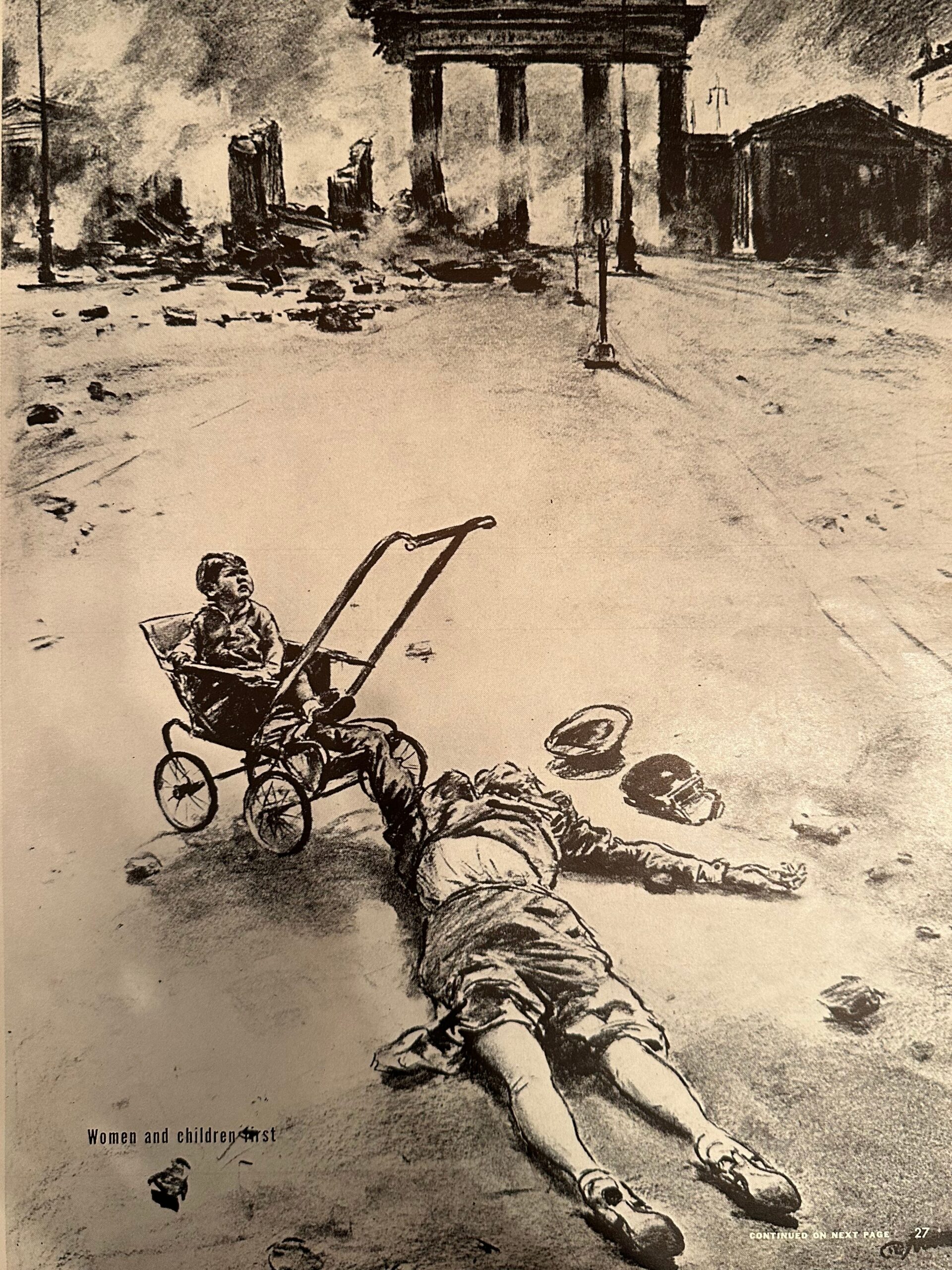
His prophecy came true. This was Berlin in May of 1945, six years after the photo:
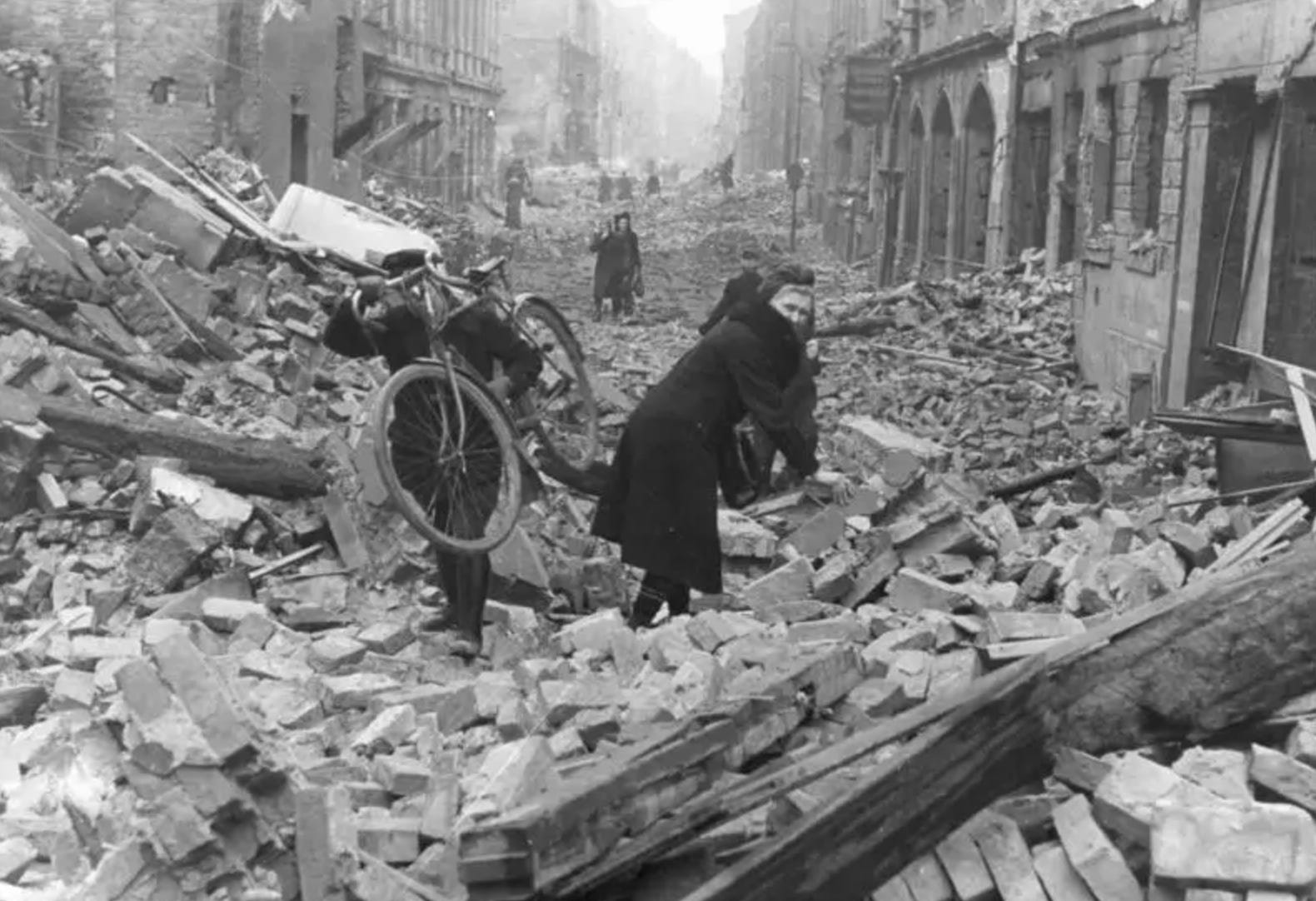
By then, the Führer’s war had been fought in ten thousand different locations on oceans and across continents, until 100 million were dead, and the world stood shattered, but for one great power: the United States of America.
Looking at old Life magazine covers from around July 4th is a revelation.
They chart our country’s journey from peace to war to possibility and prosperity.
They are a visual record of an unfolding story with poignant chapters.
Here is the cover from July 5, 1943:
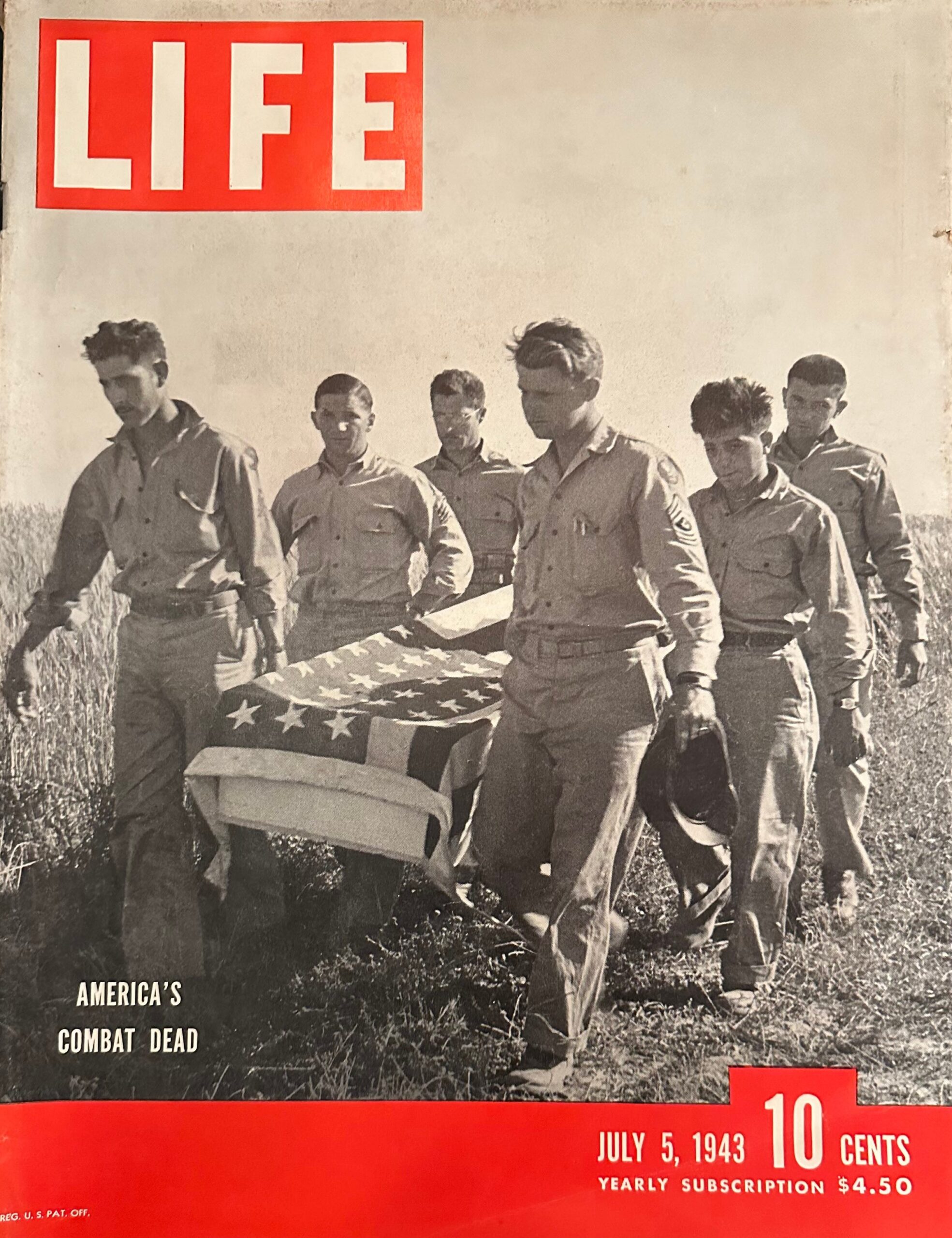
Young Americans were dying. Every state and territory had made a blood sacrifice. It was all still just beginning.
The print copy lists the names of 12,987 dead Americans, killed in action, though by publication the numbers had reached 15,132.
The names stretch across 27 pages.
The war would go on for another 673 days.
I know now that on May 29, 2004, the 43rd president of the United States commemorated a memorial to victory in that war, which memorializes 405,399 killed in action.
I know the war in Europe ended on May 8, 1945, with this simple cable from General Eisenhower, not yet famous by 1943:
The mission of this Allied Force was fulfilled at 0241 local time, May 7, 1945.
The moment captured in Life magazine is an awful preface for tremendous sacrifice to come. The greatest magazine of its era was putting the most important question of the day forward. It remains worth asking now.
It is a question that must be recalled because the answer is essential.
Why?
Why did those men die, and what was the meaning of their death?
We will soon decide again for nothing endures. Nothing holds steady.
The living write a future that judges the past by rejecting or embracing it.
Within that judgement comes the responsibility to preserve the meaning of American lives lived with purpose.
It is within our power to steal that purpose and render the lives of our dead meaningless, should we so choose to do so.
It indicts only us, never them, but unless we can honor them by giving their death meaning, then we will have desecrated their lives.
Perhaps none of this matters, but if that is so, then the virtues necessary to sustain the nation are gone and dead. I do not believe that is the case.
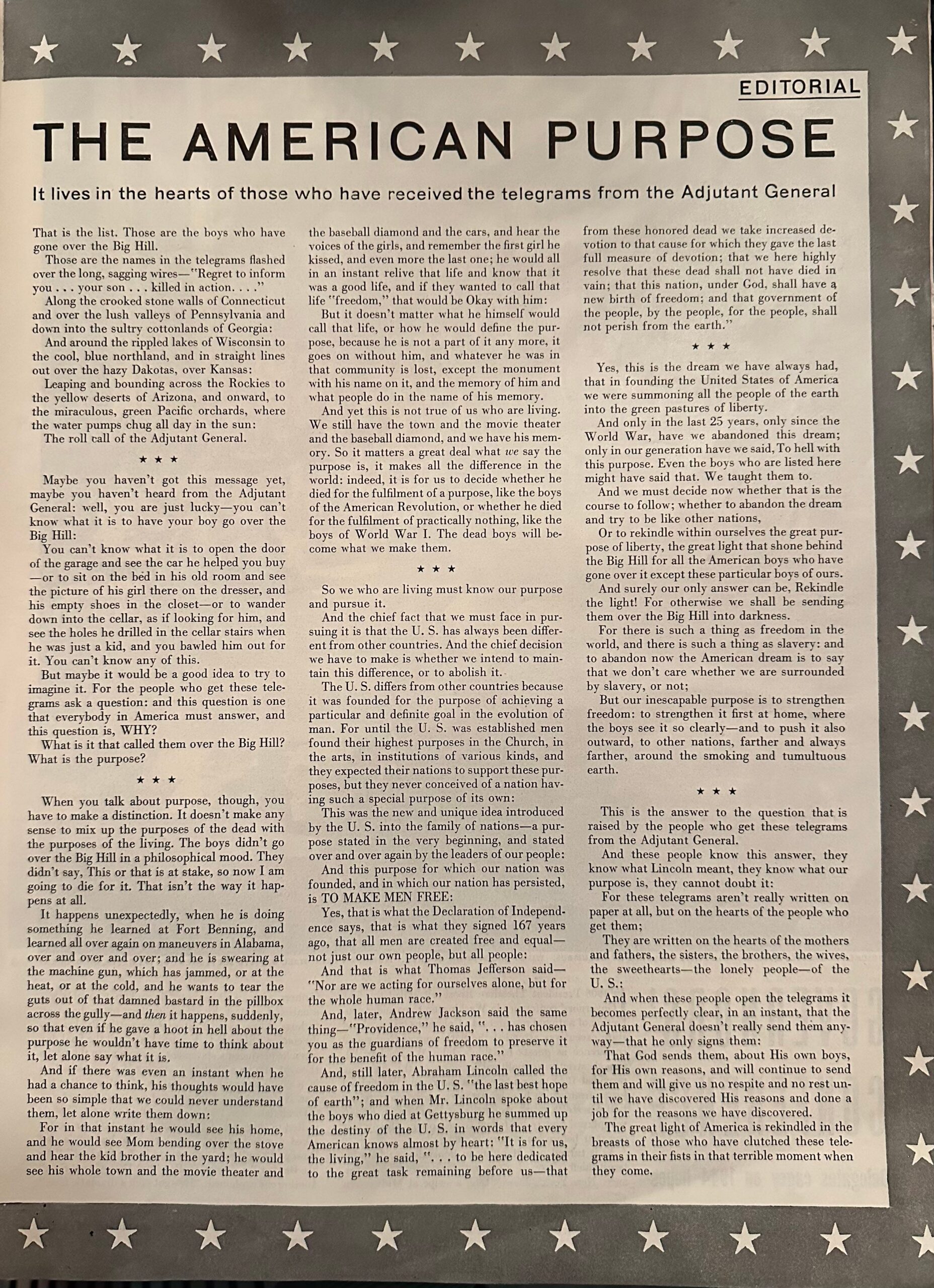
Eighty-one years ago, in the middle of the storm, thrashed by doubt, at the edge of tremendous sacrifice a great magazine put forward a deep question about the American purpose that I am pleased to share with you on the eve of this Thanksgiving.
I hope you will read it, and understand that we remain those people. We are connected to them, as our descendants will be as well.
By the way, I wish I could tell the unnamed writer what became of the people he doubted in the moment at the edge of the storm.
I’d like to tell him that, in 2024, we remember them as the greatest generation.
What I’d like to tell my children is that the greatest generation of Americans is not yet born.
We will know who they are when, someday, they can look back from a momentous summit prophesied in a dream by the only King that matters in America, who saw a just society from a mountain top.
When the “city on the hill” is well and fully built, that generation of Americans will have given meaning to all of our lives.
Justice will have been truly established, and the greatest generation truly revealed.

Steve Schmidt
Steve Schmidt is a political analyst for MSNBC and NBC News. He served as a political strategist for George W. Bush and the John McCain presidential campaign. Schmidt is a founder of The Lincoln Project, a group founded to campaign against former President Trump. It became the most financially successful Super-PAC in American history, raising almost $100 million to campaign against Trump's failed 2020 re-election bid. He left the group in 2021.