Former Speaker of the U.S. House Newt Gingrich speaking at the Republican Leadership Conference in New Orleans, Louisiana. Image: Gage Skidmore, Wiki Commons
A Reality Check on the GOP Promise to Balance the Federal Budget
Former Speaker of the U.S. House Newt Gingrich speaking at the Republican Leadership Conference in New Orleans, Louisiana. Image: Gage Skidmore, Wiki Commons
Subscribe for Updates!
Join our mailing list to receive the latest news and updates from our team.
You have Successfully Subscribed!
A quick look back at how we briefly balanced the budget twenty years ago, along with how much has changed, shows that Republicans are unlikely to manage a similar performance.
Kevin McCarthy reportedly promised many things to Republican hardliners en route to clinching his job as speaker of the U.S. House of Representatives. One of them was a “balanced budget” in 10 years.
But a look at the numbers—and the history—shows just how difficult balancing the budget will be.
Doing so requires the federal government to generate enough income to pay for all its spending. The U.S. has managed this feat only twice in the past 60 years—and both times involved raising taxes, something Republicans are loath to do. President Lyndon B. Johnson managed to do it in 1969, and President Bill Clinton created a surplus that ran from the fiscal years 1998 to 2001, when he left office.
As a member of the Clinton administration in the Commerce Department from 1997 to 2001, I participated in achieving that rare balanced budget and understand the obstacles to delivering a repeat performance. A quick look back at how we did it, along with how much has changed, shows that Republicans are unlikely to manage a similar performance.
Clinton’s balanced-budget recipe was a mixture of higher revenues and lower spending, with help from a booming economy. In his second term, he also negotiated a bipartisan budget deal with Republicans.
After campaigning on a pledge to cut the deficit, Clinton raised taxes on the wealthy during his first year in office. He introduced higher top personal income tax brackets, raised corporate taxes, increased taxes on Social Security benefits, added 4.3 cents per gallon onto gas taxes and eliminated a number of itemized tax deductions. On the spending side, Clinton took advantage of the “peace dividend” that followed the collapse of the Soviet Union to reduce defense spending from 4.3% of GDP in 1993 to 2.9% by 2000.
These measures helped slash the overall deficit to 1.3% of GDP by the end of Clinton’s first term. That’s the smallest it had been in 22 years.
The higher taxes invited pushback from Republicans, who gained majorities in the House and Senate in 1995. Clinton wrangled continually with then-Republican Speaker Newt Gingrich, who forced a government shutdown that same year.
As part of budget negotiations, Congress eventually passed the Balanced Budget Act of 1997, which retained Clinton’s original tax increases but cut capital gains taxes and reduced spending on Medicare and Medicaid. Meanwhile, the economy, fueled by a tech boom, expanded rapidly during Clinton’s second term.
Higher tax rates on the wealthiest Americans, strong economic growth and continued restraint in government spending produced a budget surplus of US$69 billion in 1998. The surplus peaked in 2000 at $236 billion before falling to $128 billion in 2001. The surplus—which hasn’t been seen since—allowed the U.S. to pay down the national debt by over $450 billion.
Lessons For Today
The lesson for Republicans today is that if they are serious about balancing the budget, it will require some very unpalatable choices.
On the spending side, so-called entitlements—mandatory programs such as Social Security, Medicare and veterans benefits—now [account for almost two-thirds of the federal budget, compared with less than half when Clinton took office. Funding for these programs is set by formula, making it difficult to change. And the population of Americans 65 or older has grown by 32% since 1993, increasing demand for entitlements.
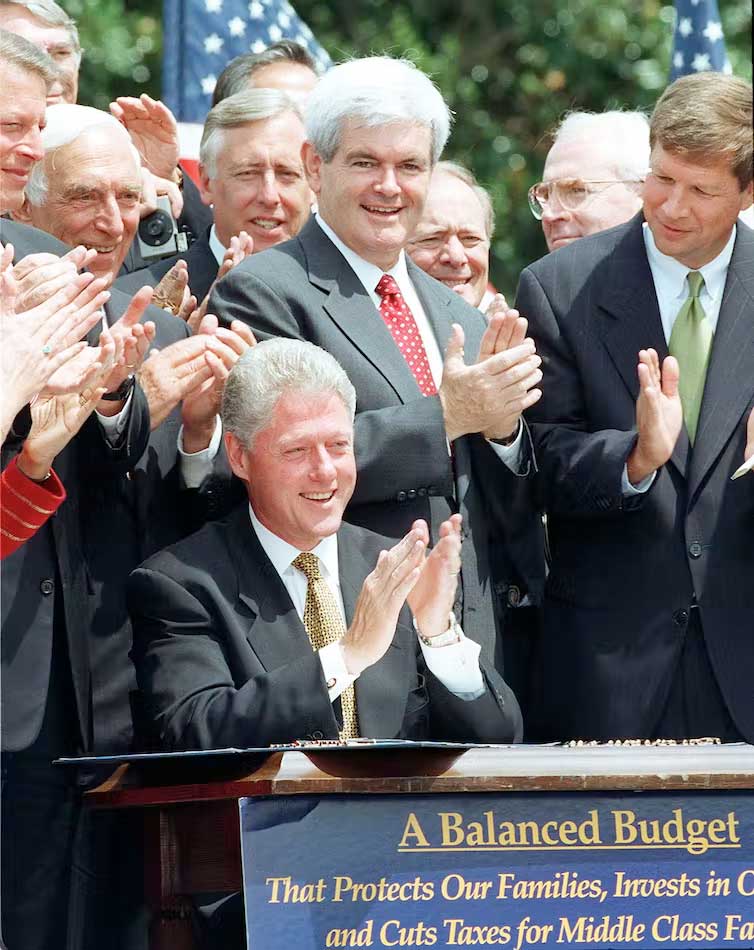
When Clinton signed the Balanced Budget Act of 1997, it was the first time since 1969 that the U.S. had made ends meet. Paul Richards/AFP via Getty Images
Defense spending takes up another 14% of taxpayer dollars, greatly exceeding every other item in the so-called discretionary budget, which includes everything else from transportation and energy to airline traffic control and national parks.
The U.S. spends 8% of the budget simply paying interest on the national debt. This percentage hasn’t changed much, but the debt itself has soared from $4.5 trillion in 1993 to $31 trillion todaymainly because of massive tax cuts during the Bush and Trump administrations, costly wars in Iraq and Afghanistan and vast public spending to address the 2008 financial crisis and the COVID-19 pandemic.
Now that historically low interest rates have come to an end, the U.S. will be forced to devote a bigger slice of the pie to paying interest.
The policy nonprofit Committee for a Responsible Federal Budget recently estimated that if spending on defense, veterans, Social Security and Medicare were off the table, Congress would need to reduce all other spending by 85% to get to an overall balance. In other words, simple arithmetic means it is not feasible to achieve anything close to a balanced budget without addressing military spending and entitlement programs.
Reducing military spending is always controversial—and many Republicans (as well as some Democrats) would resist such cuts—but especially so at a time when the U.S. is ramping up military aid to Ukraine and the Pentagon perceives a threat from China. It’s the very opposite of the Clinton-era peace dividend.
Cutting mandatory spending would require significant reforms. The U.S. has one of the youngest minimum retirement thresholds in the world, at age 62, compared with 65 in Canada and 67 in Britain and Germany. Even France may soon have a higher minimum retirement age of 64—though the current protests there over increasing it from 62 illustrate the political perils of such a change.
Can They Do It Again?
Certainly, opportunities do exist to close the gap between income and spending.
The Congressional Budget Office has released a report outlining 76 options for reducing the deficit. But many of the ideas require further hard choices, such as rolling back some or all of the last three tax cuts, increasing taxes on the wealthy, ending or curtailing tax deductions and adopting a consumption-based value-added tax or a carbon tax, as well as fundamental reforms to entitlement programs.
Unfortunately, Congress shows limited appetite to tackle such issues.
Back in 1997, after the smoke cleared, both the Clinton administration and the Republicans in Congress were able to claim some political credit for the resulting budget surpluses. But—crucially—both parties recognized that a deal was in the best interest of the country and were able to line up their respective members to get the votes in Congress needed to approve it. The contrast with the current political landscape is stark.
The Republican Study Committee, a bloc of more than 160 conservative lawmakers, released a budget blueprint in June 2022 that promises to balance the budget in seven years. The plan proposes trillions of dollars in spending cuts, many of which would fall hardest on low-income Americans. These include shrinking Medicaid, paring veterans benefits and raising the age for full Social Security retirement benefits from 67 to 70. It also calls for higher military spending and further tax cuts—which would require even more draconian cuts to core safety net programs.
It would also lock in the Trump tax cuts of 2017—the opposite of what the Congressional Budget Office recommends or what Clinton did in the 1990s to secure a balanced budget.
Without a credible Republican deficit-cutting plan on the table, I believe that the odds favor a protracted stand-off over the debt ceiling, which could tip the precarious U.S. economy into recession.
While Congress seems highly unlikely to allow a debt default, this brawl would waste time and energy that could be better spent on figuring out how to strengthen programs like Social Security and close tax loopholes that drain revenue.
Balancing the budget is not an end in itself. Most economists agree that governments should reduce public debt during periods of prosperity and run deficits to assist people when the economy is weak.
The U.S. was fortunate in the late 1990s to enjoy a buoyant economy that enabled Congress and the president to achieve a fiscal surplus. What the country needs now, in my view, is not more quick fixes but a sustainable pathway to stabilizing the national debt. That requires growing revenues and reducing nonessential spending in a responsible way.
The Conversation is a nonprofit, independent news organization dedicated to unlocking the knowledge of experts for the public good. We publish trustworthy and informative articles written by academic experts for the general public and edited by our team of journalists.
{"id":null,"mode":"form","open_style":"in_place","currency_code":"USD","currency_symbol":"$","currency_type":"decimal","blank_flag_url":"https:\/\/factkeepers.com\/wp-content\/plugins\/tip-jar-wp\/\/assets\/images\/flags\/blank.gif","flag_sprite_url":"https:\/\/factkeepers.com\/wp-content\/plugins\/tip-jar-wp\/\/assets\/images\/flags\/flags.png","default_amount":500,"top_media_type":"none","featured_image_url":false,"featured_embed":"","header_media":null,"file_download_attachment_data":null,"recurring_options_enabled":true,"recurring_options":{"never":{"selected":true,"after_output":"One time only"},"weekly":{"selected":false,"after_output":"Every week"},"monthly":{"selected":false,"after_output":"Every month"},"yearly":{"selected":false,"after_output":"Every year"}},"strings":{"current_user_email":"","current_user_name":"","link_text":"Leave a tip","complete_payment_button_error_text":"Check info and try again","payment_verb":"Pay","payment_request_label":"Factkeepers.com","form_has_an_error":"Please check and fix the errors above","general_server_error":"Something isn't working right at the moment. Please try again.","form_title":"Help Support Factkeepers","form_subtitle":null,"currency_search_text":"Country or Currency here","other_payment_option":"Other payment option","manage_payments_button_text":"Manage your payments","thank_you_message":"Thank you for being a supporter!","payment_confirmation_title":"Factkeepers.com","receipt_title":"Your Receipt","print_receipt":"Print Receipt","email_receipt":"Email Receipt","email_receipt_sending":"Sending receipt...","email_receipt_success":"Email receipt successfully sent","email_receipt_failed":"Email receipt failed to send. Please try again.","receipt_payee":"Paid to","receipt_statement_descriptor":"This will show up on your statement as","receipt_date":"Date","receipt_transaction_id":"Transaction ID","receipt_transaction_amount":"Amount","refund_payer":"Refund from","login":"Log in to manage your payments","manage_payments":"Manage Payments","transactions_title":"Your Transactions","transaction_title":"Transaction Receipt","transaction_period":"Plan Period","arrangements_title":"Your Plans","arrangement_title":"Manage Plan","arrangement_details":"Plan Details","arrangement_id_title":"Plan ID","arrangement_payment_method_title":"Payment Method","arrangement_amount_title":"Plan Amount","arrangement_renewal_title":"Next renewal date","arrangement_action_cancel":"Cancel Plan","arrangement_action_cant_cancel":"Cancelling is currently not available.","arrangement_action_cancel_double":"Are you sure you'd like to cancel?","arrangement_cancelling":"Cancelling Plan...","arrangement_cancelled":"Plan Cancelled","arrangement_failed_to_cancel":"Failed to cancel plan","back_to_plans":"\u2190 Back to Plans","update_payment_method_verb":"Update","sca_auth_description":"Your have a pending renewal payment which requires authorization.","sca_auth_verb":"Authorize renewal payment","sca_authing_verb":"Authorizing payment","sca_authed_verb":"Payment successfully authorized!","sca_auth_failed":"Unable to authorize! Please try again.","login_button_text":"Log in","login_form_has_an_error":"Please check and fix the errors above","uppercase_search":"Search","lowercase_search":"search","uppercase_page":"Page","lowercase_page":"page","uppercase_items":"Items","lowercase_items":"items","uppercase_per":"Per","lowercase_per":"per","uppercase_of":"Of","lowercase_of":"of","back":"Back to plans","zip_code_placeholder":"Zip\/Postal Code","download_file_button_text":"Download File","input_field_instructions":{"tip_amount":{"placeholder_text":"How much would you like to donate? You can change this amount to anything you would like.","initial":{"instruction_type":"normal","instruction_message":"How much would you like to donate? You can change this amount to anything you would like."},"empty":{"instruction_type":"error","instruction_message":"How much would you like to donate? You can change this amount to anything you would like."},"invalid_curency":{"instruction_type":"error","instruction_message":"How much would you like to donate? You can change this amount to anything you would like."}},"recurring":{"placeholder_text":"Recurring","initial":{"instruction_type":"normal","instruction_message":"How often would you like to donate this?"},"success":{"instruction_type":"success","instruction_message":"How often would you like to donate this?"},"empty":{"instruction_type":"error","instruction_message":"How often would you like to donate this?"}},"name":{"placeholder_text":"Name on Credit Card","initial":{"instruction_type":"normal","instruction_message":"Enter the name on your card."},"success":{"instruction_type":"success","instruction_message":"Enter the name on your card."},"empty":{"instruction_type":"error","instruction_message":"Please enter the name on your card."}},"privacy_policy":{"terms_title":"Terms and conditions","terms_body":null,"terms_show_text":"View Terms","terms_hide_text":"Hide Terms","initial":{"instruction_type":"normal","instruction_message":"I agree to the terms."},"unchecked":{"instruction_type":"error","instruction_message":"Please agree to the terms."},"checked":{"instruction_type":"success","instruction_message":"I agree to the terms."}},"email":{"placeholder_text":"Your email address","initial":{"instruction_type":"normal","instruction_message":"Enter your email address"},"success":{"instruction_type":"success","instruction_message":"Enter your email address"},"blank":{"instruction_type":"error","instruction_message":"Enter your email address"},"not_an_email_address":{"instruction_type":"error","instruction_message":"Make sure you have entered a valid email address"}},"note_with_tip":{"placeholder_text":"Your note here...","initial":{"instruction_type":"normal","instruction_message":"Attach a note to your tip (optional)"},"empty":{"instruction_type":"normal","instruction_message":"Attach a note to your tip (optional)"},"not_empty_initial":{"instruction_type":"normal","instruction_message":"Attach a note to your tip (optional)"},"saving":{"instruction_type":"normal","instruction_message":"Saving note..."},"success":{"instruction_type":"success","instruction_message":"Note successfully saved!"},"error":{"instruction_type":"error","instruction_message":"Unable to save note note at this time. Please try again."}},"email_for_login_code":{"placeholder_text":"Your email address","initial":{"instruction_type":"normal","instruction_message":"Enter your email to log in."},"success":{"instruction_type":"success","instruction_message":"Enter your email to log in."},"blank":{"instruction_type":"error","instruction_message":"Enter your email to log in."},"empty":{"instruction_type":"error","instruction_message":"Enter your email to log in."}},"login_code":{"initial":{"instruction_type":"normal","instruction_message":"Check your email and enter the login code."},"success":{"instruction_type":"success","instruction_message":"Check your email and enter the login code."},"blank":{"instruction_type":"error","instruction_message":"Check your email and enter the login code."},"empty":{"instruction_type":"error","instruction_message":"Check your email and enter the login code."}},"stripe_all_in_one":{"initial":{"instruction_type":"normal","instruction_message":"Enter your credit card details here."},"empty":{"instruction_type":"error","instruction_message":"Enter your credit card details here."},"success":{"instruction_type":"normal","instruction_message":"Enter your credit card details here."},"invalid_number":{"instruction_type":"error","instruction_message":"The card number is not a valid credit card number."},"invalid_expiry_month":{"instruction_type":"error","instruction_message":"The card's expiration month is invalid."},"invalid_expiry_year":{"instruction_type":"error","instruction_message":"The card's expiration year is invalid."},"invalid_cvc":{"instruction_type":"error","instruction_message":"The card's security code is invalid."},"incorrect_number":{"instruction_type":"error","instruction_message":"The card number is incorrect."},"incomplete_number":{"instruction_type":"error","instruction_message":"The card number is incomplete."},"incomplete_cvc":{"instruction_type":"error","instruction_message":"The card's security code is incomplete."},"incomplete_expiry":{"instruction_type":"error","instruction_message":"The card's expiration date is incomplete."},"incomplete_zip":{"instruction_type":"error","instruction_message":"The card's zip code is incomplete."},"expired_card":{"instruction_type":"error","instruction_message":"The card has expired."},"incorrect_cvc":{"instruction_type":"error","instruction_message":"The card's security code is incorrect."},"incorrect_zip":{"instruction_type":"error","instruction_message":"The card's zip code failed validation."},"invalid_expiry_year_past":{"instruction_type":"error","instruction_message":"The card's expiration year is in the past"},"card_declined":{"instruction_type":"error","instruction_message":"The card was declined."},"missing":{"instruction_type":"error","instruction_message":"There is no card on a customer that is being charged."},"processing_error":{"instruction_type":"error","instruction_message":"An error occurred while processing the card."},"invalid_request_error":{"instruction_type":"error","instruction_message":"Unable to process this payment, please try again or use alternative method."},"invalid_sofort_country":{"instruction_type":"error","instruction_message":"The billing country is not accepted by SOFORT. Please try another country."}}}},"fetched_oembed_html":false}