Join our mailing list to receive the latest news and updates from our team.
You have Successfully Subscribed!
An internal Facebook report found that the social media platform’s algorithms enabled disinformation campaigns based in Eastern Europe to reach nearly half of all Americans in the run-up to the 2020 presidential election.
An internal Facebook report found that the social media platform’s algorithms – the rules its computers follow in deciding the content that you see – enabled disinformation campaigns based in Eastern Europe to reach nearly half of all Americans in the run-up to the 2020 presidential election, according to a report in Technology Review.
The campaigns produced the most popular pages for Christian and Black American content, and overall reached 140 million U.S. users per month. Seventy-five percent of the people exposed to the content hadn’t followed any of the pages. People saw the content because Facebook’s content-recommendation system put it into their news feeds.
Social media platforms rely heavily on people’s behavior to decide on the content that you see. In particular, they watch for content that people respond to or “engage” with by liking, commenting and sharing. Troll farms, organizations that spread provocative content, exploit this by copying high-engagement content and posting it as their own.
As a computer scientist who studies the ways large numbers of people interact using technology, I understand the logic of using the wisdom of the crowds in these algorithms. I also see substantial pitfalls in how the social media companies do so in practice.
From lions on the savanna to likes on Facebook
The concept of the wisdom of crowds assumes that using signals from others’ actions, opinions and preferences as a guide will lead to sound decisions. For example, collective predictions are normally more accurate than individual ones. Collective intelligence is used to predict financial markets, sports, elections and even disease outbreaks.
Throughout millions of years of evolution, these principles have been coded into the human brain in the form of cognitive biases that come with names like familiarity, mere exposure and bandwagon effect. If everyone starts running, you should also start running; maybe someone saw a lion coming and running could save your life. You may not know why, but it’s wiser to ask questions later.
Your brain picks up clues from the environment – including your peers – and uses simple rules to quickly translate those signals into decisions: Go with the winner, follow the majority, copy your neighbor. These rules work remarkably well in typical situations because they are based on sound assumptions. For example, they assume that people often act rationally, it is unlikely that many are wrong, the past predicts the future, and so on.
Technology allows people to access signals from much larger numbers of other people, most of whom they do not know. Artificial intelligence applications make heavy use of these popularity or “engagement” signals, from selecting search engine results to recommending music and videos, and from suggesting friends to ranking posts on news feeds.
Not everything viral deserves to be
Our research shows that virtually all web technology platforms, such as social media and news recommendation systems, have a strong popularity bias. When applications are driven by cues like engagement rather than explicit search engine queries, popularity bias can lead to harmful unintended consequences.
Social media like Facebook, Instagram, Twitter, YouTube and TikTok rely heavily on AI algorithms to rank and recommend content. These algorithms take as input what you like, comment on and share – in other words, content you engage with. The goal of the algorithms is to maximize engagement by finding out what people like and ranking it at the top of their feeds.
A primer on the Facebook algorithm.
On the surface this seems reasonable. If people like credible news, expert opinions and fun videos, these algorithms should identify such high-quality content. But the wisdom of the crowds makes a key assumption here: that recommending what is popular will help high-quality content “bubble up.”
We tested this assumption by studying an algorithm that ranks items using a mix of quality and popularity. We found that in general, popularity bias is more likely to lower the overall quality of content. The reason is that engagement is not a reliable indicator of quality when few people have been exposed to an item. In these cases, engagement generates a noisy signal, and the algorithm is likely to amplify this initial noise. Once the popularity of a low-quality item is large enough, it will keep getting amplified.
Algorithms aren’t the only thing affected by engagement bias – it can affect people too. Evidence shows that information is transmitted via “complex contagion,” meaning the more times people are exposed to an idea online, the more likely they are to adopt and reshare it. When social media tells people an item is going viral, their cognitive biases kick in and translate into the irresistible urge to pay attention to it and share it.
Not-so-wise crowds
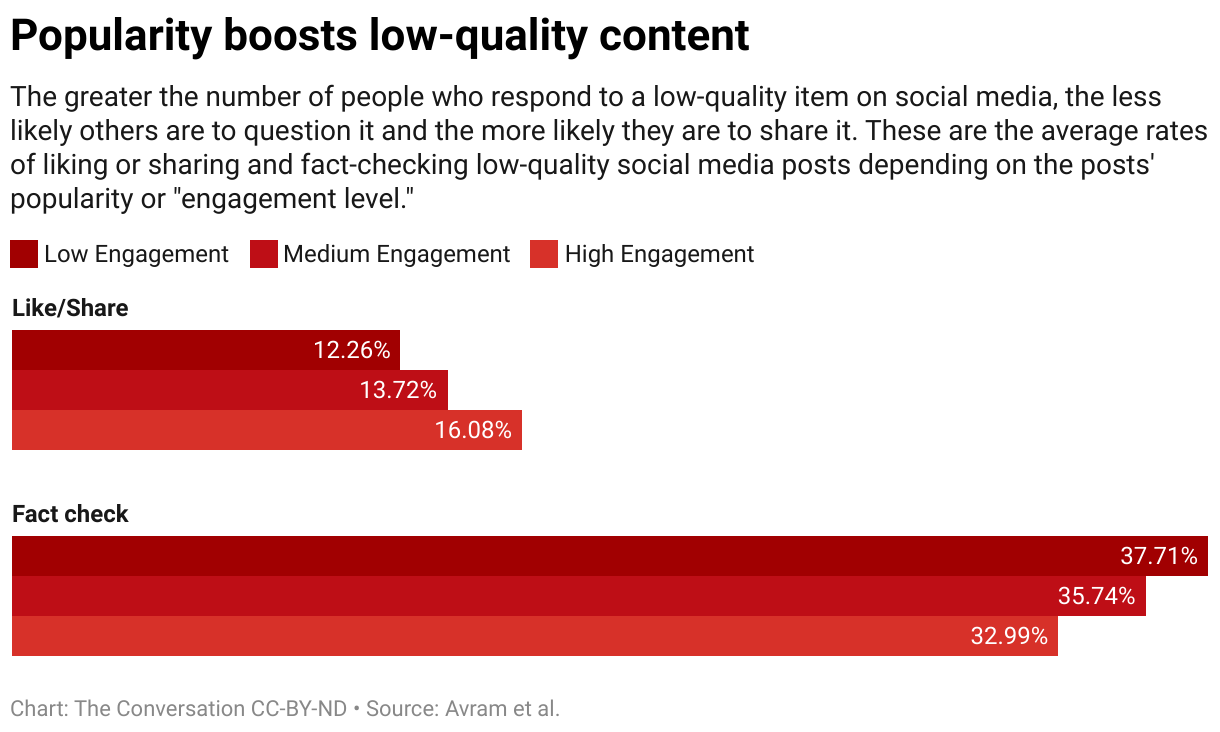
We recently ran an experiment using a news literacy app called Fakey. It is a game developed by our lab, which simulates a news feed like those of Facebook and Twitter. Players see a mix of current articles from fake news, junk science, hyperpartisan and conspiratorial sources, as well as mainstream sources. They get points for sharing or liking news from reliable sources and for flagging low-credibility articles for fact-checking.
We found that players are more likely to like or share and less likely to flag articles from low-credibility sources when players can see that many other users have engaged with those articles. Exposure to the engagement metrics thus creates a vulnerability.
The wisdom of the crowds fails because it is built on the false assumption that the crowd is made up of diverse, independent sources. There may be several reasons this is not the case.
First, because of people’s tendency to associate with similar people, their online neighborhoods are not very diverse. The ease with which social media users can unfriend those with whom they disagree pushes people into homogeneous communities, often referred to as echo chambers.
Second, because many people’s friends are friends of one another, they influence one another. A famous experiment demonstrated that knowing what music your friends like affects your own stated preferences. Your social desire to conform distorts your independent judgment.
Third, popularity signals can be gamed. Over the years, search engines have developed sophisticated techniques to counter so-called “link farms” and other schemes to manipulate search algorithms. Social media platforms, on the other hand, are just beginning to learn about their own vulnerabilities.
A different, preventive approach would be to add friction. In other words, to slow down the process of spreading information. High-frequency behaviors such as automated liking and sharing could be inhibited by CAPTCHA tests or fees. Not only would this decrease opportunities for manipulation, but with less information people would be able to pay more attention to what they see. It would leave less room for engagement bias to affect people’s decisions.
It would also help if social media companies adjusted their algorithms to rely less on engagement to determine the content they serve you. Perhaps the revelations of Facebook’s knowledge of troll farms exploiting engagement will provide the necessary impetus.
The Conversation is a nonprofit, independent news organization dedicated to unlocking the knowledge of experts for the public good. We publish trustworthy and informative articles written by academic experts for the general public and edited by our team of journalists.
{"id":null,"mode":"form","open_style":"in_place","currency_code":"USD","currency_symbol":"$","currency_type":"decimal","blank_flag_url":"https:\/\/factkeepers.com\/wp-content\/plugins\/tip-jar-wp\/\/assets\/images\/flags\/blank.gif","flag_sprite_url":"https:\/\/factkeepers.com\/wp-content\/plugins\/tip-jar-wp\/\/assets\/images\/flags\/flags.png","default_amount":500,"top_media_type":"none","featured_image_url":false,"featured_embed":"","header_media":null,"file_download_attachment_data":null,"recurring_options_enabled":true,"recurring_options":{"never":{"selected":true,"after_output":"One time only"},"weekly":{"selected":false,"after_output":"Every week"},"monthly":{"selected":false,"after_output":"Every month"},"yearly":{"selected":false,"after_output":"Every year"}},"strings":{"current_user_email":"","current_user_name":"","link_text":"Leave a tip","complete_payment_button_error_text":"Check info and try again","payment_verb":"Pay","payment_request_label":"Factkeepers.com","form_has_an_error":"Please check and fix the errors above","general_server_error":"Something isn't working right at the moment. Please try again.","form_title":"Help Support Factkeepers","form_subtitle":null,"currency_search_text":"Country or Currency here","other_payment_option":"Other payment option","manage_payments_button_text":"Manage your payments","thank_you_message":"Thank you for being a supporter!","payment_confirmation_title":"Factkeepers.com","receipt_title":"Your Receipt","print_receipt":"Print Receipt","email_receipt":"Email Receipt","email_receipt_sending":"Sending receipt...","email_receipt_success":"Email receipt successfully sent","email_receipt_failed":"Email receipt failed to send. Please try again.","receipt_payee":"Paid to","receipt_statement_descriptor":"This will show up on your statement as","receipt_date":"Date","receipt_transaction_id":"Transaction ID","receipt_transaction_amount":"Amount","refund_payer":"Refund from","login":"Log in to manage your payments","manage_payments":"Manage Payments","transactions_title":"Your Transactions","transaction_title":"Transaction Receipt","transaction_period":"Plan Period","arrangements_title":"Your Plans","arrangement_title":"Manage Plan","arrangement_details":"Plan Details","arrangement_id_title":"Plan ID","arrangement_payment_method_title":"Payment Method","arrangement_amount_title":"Plan Amount","arrangement_renewal_title":"Next renewal date","arrangement_action_cancel":"Cancel Plan","arrangement_action_cant_cancel":"Cancelling is currently not available.","arrangement_action_cancel_double":"Are you sure you'd like to cancel?","arrangement_cancelling":"Cancelling Plan...","arrangement_cancelled":"Plan Cancelled","arrangement_failed_to_cancel":"Failed to cancel plan","back_to_plans":"\u2190 Back to Plans","update_payment_method_verb":"Update","sca_auth_description":"Your have a pending renewal payment which requires authorization.","sca_auth_verb":"Authorize renewal payment","sca_authing_verb":"Authorizing payment","sca_authed_verb":"Payment successfully authorized!","sca_auth_failed":"Unable to authorize! Please try again.","login_button_text":"Log in","login_form_has_an_error":"Please check and fix the errors above","uppercase_search":"Search","lowercase_search":"search","uppercase_page":"Page","lowercase_page":"page","uppercase_items":"Items","lowercase_items":"items","uppercase_per":"Per","lowercase_per":"per","uppercase_of":"Of","lowercase_of":"of","back":"Back to plans","zip_code_placeholder":"Zip\/Postal Code","download_file_button_text":"Download File","input_field_instructions":{"tip_amount":{"placeholder_text":"How much would you like to donate? You can change this amount to anything you would like.","initial":{"instruction_type":"normal","instruction_message":"How much would you like to donate? You can change this amount to anything you would like."},"empty":{"instruction_type":"error","instruction_message":"How much would you like to donate? You can change this amount to anything you would like."},"invalid_curency":{"instruction_type":"error","instruction_message":"How much would you like to donate? You can change this amount to anything you would like."}},"recurring":{"placeholder_text":"Recurring","initial":{"instruction_type":"normal","instruction_message":"How often would you like to donate this?"},"success":{"instruction_type":"success","instruction_message":"How often would you like to donate this?"},"empty":{"instruction_type":"error","instruction_message":"How often would you like to donate this?"}},"name":{"placeholder_text":"Name on Credit Card","initial":{"instruction_type":"normal","instruction_message":"Enter the name on your card."},"success":{"instruction_type":"success","instruction_message":"Enter the name on your card."},"empty":{"instruction_type":"error","instruction_message":"Please enter the name on your card."}},"privacy_policy":{"terms_title":"Terms and conditions","terms_body":null,"terms_show_text":"View Terms","terms_hide_text":"Hide Terms","initial":{"instruction_type":"normal","instruction_message":"I agree to the terms."},"unchecked":{"instruction_type":"error","instruction_message":"Please agree to the terms."},"checked":{"instruction_type":"success","instruction_message":"I agree to the terms."}},"email":{"placeholder_text":"Your email address","initial":{"instruction_type":"normal","instruction_message":"Enter your email address"},"success":{"instruction_type":"success","instruction_message":"Enter your email address"},"blank":{"instruction_type":"error","instruction_message":"Enter your email address"},"not_an_email_address":{"instruction_type":"error","instruction_message":"Make sure you have entered a valid email address"}},"note_with_tip":{"placeholder_text":"Your note here...","initial":{"instruction_type":"normal","instruction_message":"Attach a note to your tip (optional)"},"empty":{"instruction_type":"normal","instruction_message":"Attach a note to your tip (optional)"},"not_empty_initial":{"instruction_type":"normal","instruction_message":"Attach a note to your tip (optional)"},"saving":{"instruction_type":"normal","instruction_message":"Saving note..."},"success":{"instruction_type":"success","instruction_message":"Note successfully saved!"},"error":{"instruction_type":"error","instruction_message":"Unable to save note note at this time. Please try again."}},"email_for_login_code":{"placeholder_text":"Your email address","initial":{"instruction_type":"normal","instruction_message":"Enter your email to log in."},"success":{"instruction_type":"success","instruction_message":"Enter your email to log in."},"blank":{"instruction_type":"error","instruction_message":"Enter your email to log in."},"empty":{"instruction_type":"error","instruction_message":"Enter your email to log in."}},"login_code":{"initial":{"instruction_type":"normal","instruction_message":"Check your email and enter the login code."},"success":{"instruction_type":"success","instruction_message":"Check your email and enter the login code."},"blank":{"instruction_type":"error","instruction_message":"Check your email and enter the login code."},"empty":{"instruction_type":"error","instruction_message":"Check your email and enter the login code."}},"stripe_all_in_one":{"initial":{"instruction_type":"normal","instruction_message":"Enter your credit card details here."},"empty":{"instruction_type":"error","instruction_message":"Enter your credit card details here."},"success":{"instruction_type":"normal","instruction_message":"Enter your credit card details here."},"invalid_number":{"instruction_type":"error","instruction_message":"The card number is not a valid credit card number."},"invalid_expiry_month":{"instruction_type":"error","instruction_message":"The card's expiration month is invalid."},"invalid_expiry_year":{"instruction_type":"error","instruction_message":"The card's expiration year is invalid."},"invalid_cvc":{"instruction_type":"error","instruction_message":"The card's security code is invalid."},"incorrect_number":{"instruction_type":"error","instruction_message":"The card number is incorrect."},"incomplete_number":{"instruction_type":"error","instruction_message":"The card number is incomplete."},"incomplete_cvc":{"instruction_type":"error","instruction_message":"The card's security code is incomplete."},"incomplete_expiry":{"instruction_type":"error","instruction_message":"The card's expiration date is incomplete."},"incomplete_zip":{"instruction_type":"error","instruction_message":"The card's zip code is incomplete."},"expired_card":{"instruction_type":"error","instruction_message":"The card has expired."},"incorrect_cvc":{"instruction_type":"error","instruction_message":"The card's security code is incorrect."},"incorrect_zip":{"instruction_type":"error","instruction_message":"The card's zip code failed validation."},"invalid_expiry_year_past":{"instruction_type":"error","instruction_message":"The card's expiration year is in the past"},"card_declined":{"instruction_type":"error","instruction_message":"The card was declined."},"missing":{"instruction_type":"error","instruction_message":"There is no card on a customer that is being charged."},"processing_error":{"instruction_type":"error","instruction_message":"An error occurred while processing the card."},"invalid_request_error":{"instruction_type":"error","instruction_message":"Unable to process this payment, please try again or use alternative method."},"invalid_sofort_country":{"instruction_type":"error","instruction_message":"The billing country is not accepted by SOFORT. Please try another country."}}}},"fetched_oembed_html":false}